Wardley Mapping: Seeing the Landscape Before You Choose a Direction
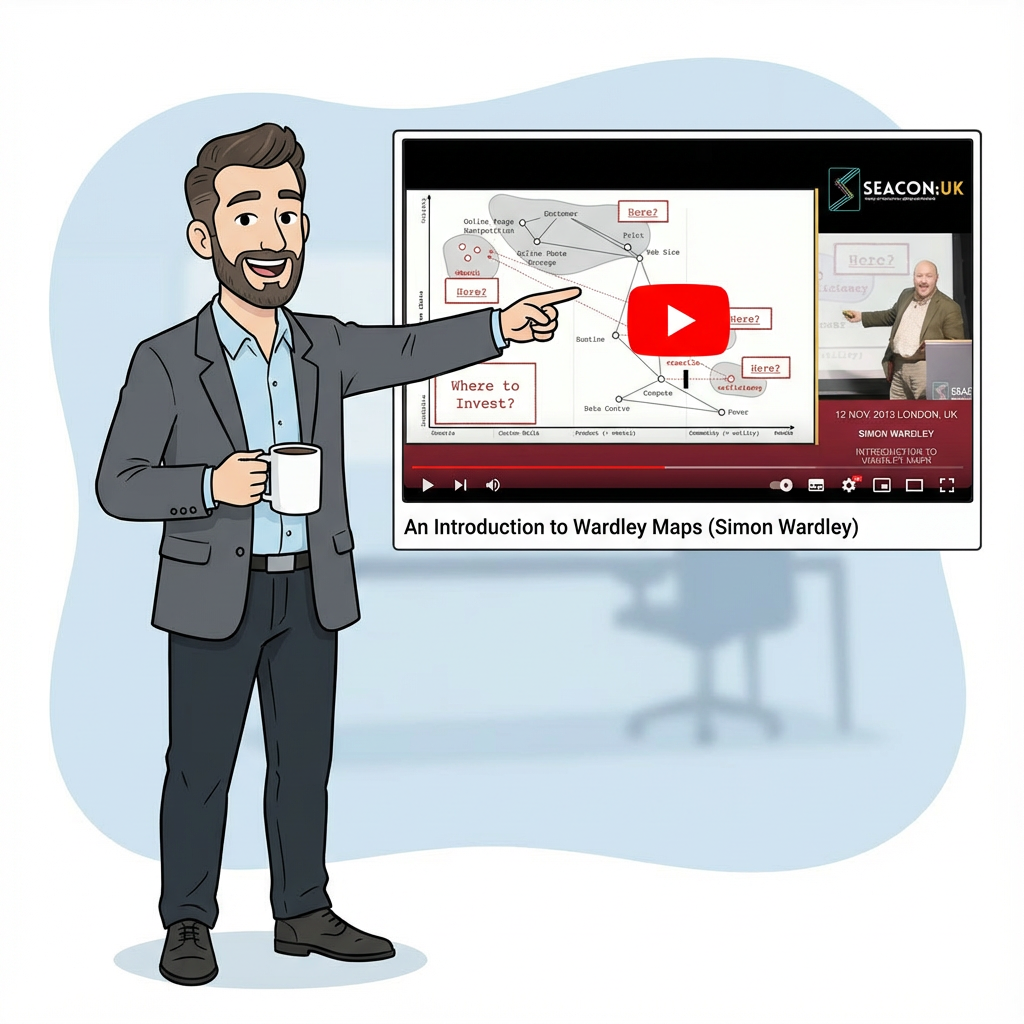
Most strategy discussions start with strong opinions and end with a familiar trade-off.
“Do we build or buy?”
“Should we modernise the platform or focus on features?”
“Is this a cost problem, a delivery problem, or a capability problem?”
The issue is rarely the intent. It is that we are deciding without a shared view of the landscape.
Wardley Mapping is a simple way to change that. It gives executives and technology leaders a practical tool to build situational awareness before they commit capital, people, and time.
What is Wardley Mapping
A Wardley Map is a view of a value chain.
It starts with a user need. Then it shows the components required to meet that need, arranged by dependency. That value chain is then plotted against how evolved each component is, from novel and uncertain through to standard and commodity.
It is not an architecture diagram. And it is not a process map.
It is a strategic picture of what matters, what it depends on, and where it sits in its lifecycle.
Why it is useful for executives
Most executive teams are not short on frameworks. They are short on clarity.
Wardley Mapping helps because it does three things well.
1) It creates shared situational awareness
You get alignment on what the system is, not just what people feel. The map becomes the common reference point.
2) It makes trade-offs visible
Some parts of the value chain are genuinely differentiating. Others are plumbing. When you can see which is which, “build vs buy” becomes less emotional and more commercial.
3) It reduces politics in the room
It is easier to challenge a map than to challenge a person’s narrative. You can disagree on placement and assumptions without the discussion turning into a debate about credibility. (That dynamic is one of the reasons Wardley focuses on maps rather than “storytelling” alone.)
For a CIO, this provides a structured way to explain technology decisions in business terms, grounded in context.
The basic mechanics
A Wardley Map has two simple axes.
The vertical axis is visibility
Things close to the user are high visibility. Things further away are supporting components.
A checkout page is visible. A runtime platform is less visible. Power and networks are barely visible.
That ordering helps leaders stop treating everything as equally important.
The horizontal axis is evolution
Components evolve through stages. The labels vary slightly by source, but the idea is consistent:
- Genesis: new, uncertain, hard to predict
- Custom-built: built to fit a specific context
- Product: available as a repeatable offering
- Commodity/Utility: standard, widely available, “boring” in the best way
This matters because method and investment should change as components evolve.
The discipline is to stop treating everything like Genesis.
Applying Wardley Mapping as a technology leader
CIOs sit in the middle of decisions that have long tails.
Platforms, vendors, architectures, and operating models tend to stay in place for years. So the goal is not to “be right” in a meeting. The goal is to make choices that are defensible, adaptable, and commercially sensible.
Wardley Mapping supports that in a few common scenarios.
Example 1: Build vs buy without the theatre
Consider a customer-facing service: ordering, fulfilment, customer support.
A map will usually show a mix of:
- components that differentiate (experience, workflow design, pricing logic, domain rules)
- components that should be industrialised (identity, infrastructure, commodity integrations, commodity hosting)
The practical takeaway is that you can split decisions:
- Differentiate where you must (and accept uncertainty, learning, iteration)
- Industrialise where you can (and demand standardisation, reliability, cost discipline)
It becomes easier to defend why some work needs product-style investment, while other work needs operational excellence.
Example 2: Avoiding “optimising the wrong thing”
One of the most expensive failure patterns in organisations is optimising local process while missing the bigger context.
Wardley Mapping is designed to surface that context. If something is effectively commodity, but treated as bespoke, the map highlights the mismatch.
This links directly to two earlier ideas in the series:
- Lean: improve flow by removing waste
- Theory of Constraints: improve the system by addressing the bottleneck, not the loudest problem
A map helps you see where the value chain is constrained, and whether the constraint is caused by a component being treated at the wrong stage of evolution.
How to start
Start with a real question, such as:
- “Where should we invest to improve customer experience without increasing cost to serve?”
- “What should we build, what should we buy, and what should we standardise?”
- “Where are we carrying avoidable complexity?”
Then run a short working session:
-
Name the user and the need
Be specific. If the “user” is internal, say which team and what outcome they need. -
List the components that meet the need
Keep it practical. If it is required to deliver the need, it is on the table. -
Draw the dependency chain
What relies on what? -
Place components roughly by evolution
You are not aiming for precision. You are surfacing assumptions. -
Ask the questions that matter
- What are we custom-building that the market already provides?
- What are we treating as commodity when it actually differentiates?
- Where are we “stuck” because a component is poorly evolved or overly bespoke?
- If we improved one thing this quarter, what would move the needle most?
The initial map should be treated as a working artefact. Its primary value is in making assumptions visible and enabling structured discussion.
What Wardley Mapping is not
Wardley Mapping does not replace delivery or execution practices. It is a way to improve the quality of strategic choices before execution begins.
Used well, it supports what most CIOs are trying to do anyway:
- align technology decisions to business intent
- make trade-offs explicit
- reduce avoidable complexity
- invest where it creates real enterprise value
And it gives executives a shared language to do that work together.
References and Further Reading
Wardley Maps. “Mapping 101: A Beginner’s Guide.” [https://wardleymaps.com/docs/map101/] Learn Wardley Mapping. “Introduction” (includes definitions and links to Simon Wardley’s free materials). [https://learnwardleymapping.com/] Wardley, S. “An Introduction to Wardley (Value Chain) Mapping.” [https://medium.com/wardleymaps/an-introduction-to-wardley-value-chain-mapping-77477429f4e2] Wardley, S. An Introduction to Wardley Mapping (video presentation). [https://www.youtube.com/watch?v=L3wgzl2iUR4]