The Toyota Way: The Philosophy Behind Lean Thinking
In the previous Lean Thinking article, we looked at flow and waste as ways to improve how value moves through an organisation.
The obvious follow-up question is: what kind of leadership makes that possible?
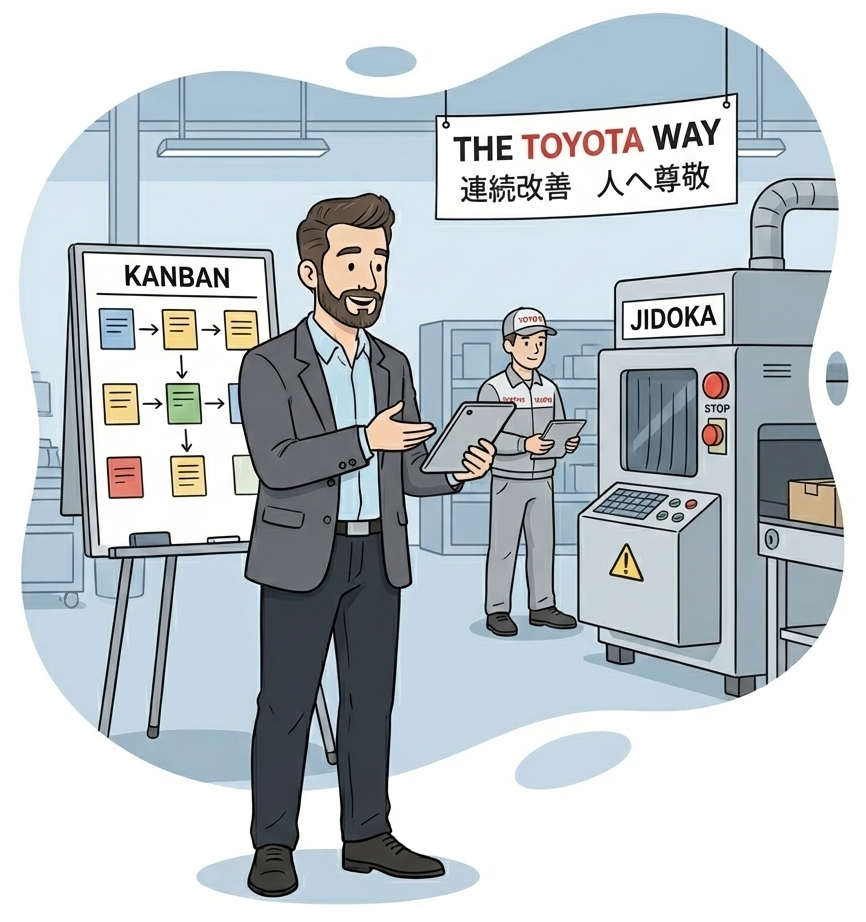
Toyota’s answer became known as The Toyota Way.
Jeffrey Liker distilled it into 14 principles, grouped into four themes: long-term philosophy, the right process, people and partners, and problem solving. 1
For executives and CIOs, these are not factory tricks. They are a coherent leadership philosophy that explains why Lean works when it does, and why it fails when treated as a toolkit.
1. Lead With a Long-Term Philosophy
Toyota emphasises a long-term philosophy, asking leaders to favour decisions that build durable value, even when short-term results take a hit. 1
The point is simple. Improvement efforts are fragile if they are constantly overridden by quarterly pressures.
A long-term philosophy:
- gives people a clear sense of purpose
- makes trade-offs explicit (speed vs stability, cost vs quality)
- creates room for learning and experimentation
For technology leaders, this might mean:
- investing in simplification rather than one more feature
- accepting short-term disruption to retire legacy systems
- backing teams who remove waste rather than maximise visible busyness
Without this foundation, Lean easily collapses into local cost-cutting.
2. Design Processes That Surface Problems
The Toyota Way assumes that the right process will produce the right results. 2
That does not mean more process. It means clearer, more honest process.
Key ideas include:
- Continuous flow to reveal delays and friction
- Pull systems so work is done when needed, not “just in case”
- Levelled workload (heijunka) to avoid peaks, burnout, and hidden queues
- Stopping to fix problems (jidoka) instead of pushing defects downstream
- Standardised work as a baseline for improvement, not a cage
- Visual controls so issues are visible, not buried in reports
- Proven technology that supports people and flow, rather than impresses on slides
For a CIO, this might look like:
- limiting work in progress across portfolio streams
- designing deployment pipelines to stop when quality drops
- using operational dashboards to highlight flow issues, not only uptime
The aim is not to hide problems. It is to make them impossible to ignore.
3. Develop People and Partners Around the Philosophy
Lean is often misread as process-centric. The Toyota Way is explicit: people and partners create the value.
Toyota emphasises:
- leaders who understand the work and live the philosophy
- teams who internalise the company’s way of thinking, not just its procedures
- suppliers and partners who are challenged and supported to improve
This is more than “culture” in the abstract.
It means leaders are expected to:
- spend time at the frontline
- teach and coach, not just review metrics
- hold themselves to the same standards they expect from others
For technology organisations, the parallel is clear:
- engineering and operations leaders who still understand the details
- teams organised around value streams, with real ownership
- vendors treated as part of the system, not just cost centres
If people do not share the underlying philosophy, Lean tools will always feel imposed.
4. Make Problem Solving the Engine of Learning
The final theme in The Toyota Way is continuously solving root problems as the driver of organisational learning. 3
Three principles stand out:
- Go and see for yourself (genchi genbutsu) to understand the real situation
- Decide slowly, implement quickly (nemawashi) based on broad input and clear commitment
- Reflect and improve (hansei and kaizen) to institutionalise learning
In practice, this means:
- leaders visit teams and sites instead of relying only on summaries
- major decisions are socialised early, so execution is fast once a direction is chosen
- post-incident and post-project reviews are about learning, not blame
For CIOs, this ties directly to incident management, architecture decisions, and change governance. The lesson is consistent: treat every significant issue as an opportunity to understand the system better and adjust it.
Two Practical Applications Outside Manufacturing
Technology strategy and platform choices
A platform decision made for short-term savings can create years of friction.
Applying The Toyota Way would mean:
- testing that decision against long-term philosophy and purpose
- checking whether it simplifies or complicates flow
- involving the people who will live with the platform in evaluation and design
- planning for structured learning once it is in use
The outcome is not perfection. It is fewer surprises and clearer trade-offs.
Service and support operations
Support teams often optimise for speed of closure.
A Toyota Way lens would shift this toward:
- surfacing repeat issues as signals of process or design problems
- standardising common fixes, then improving the upstream causes
- levelling workload to avoid constant “hero” behaviour
- using visual controls so anyone can see current demand and constraints
Over time, the work becomes less reactive because the system around the team improves.
In Summary
Lean Thinking focuses on flow and waste.
Design Thinking focuses on problems worth solving.
The Toyota Way explains how leaders need to think and behave for both to work.
For technology leaders, it offers a practical lens:
- Purpose before metrics
- Flow before local optimisation
- People before tools
- Learning before blame
References and Further Reading
-
Liker, J. K. (2004). The Toyota Way: 14 Management Principles from the World’s Greatest Manufacturer. McGraw-Hill. ↩ ↩2
-
Womack, J. P., Jones, D. T., & Roos, D. (1990). The Machine That Changed the World. Scribner. ↩
-
“The Toyota Way.” Wikipedia. A concise overview of the themes and principles. [https://en.wikipedia.org/wiki/The_Toyota_Way] ↩