Lean Thinking: Improving the Flow of Value
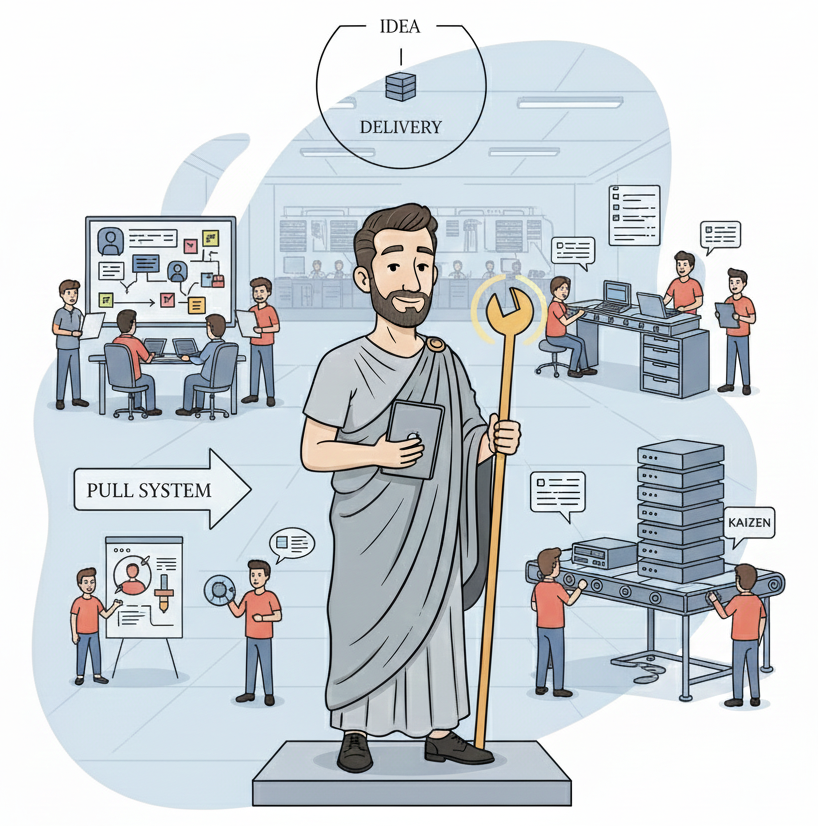
Lean is often misunderstood.
For some, it is synonymous with efficiency drives, headcount reduction, or process optimisation. For others, it is a set of tools applied during times of pressure.
In practice, Lean is something more fundamental.
It is a philosophy about how value is created, how work flows through an organisation, and how leaders choose to respond to problems. When applied well, Lean shapes decision-making, leadership behaviour, and organisational culture—not just processes.
Why Lean Still Matters
Most organisations do not struggle because they work too slowly.
They struggle because value moves inconsistently. Work queues build up. Problems are discovered late. Effort is spent optimising activities that do not materially improve outcomes.
Lean addresses this by shifting attention away from activity and toward flow of value.
For CIOs and technology leaders, this matters because technology now sits across every value stream. When flow breaks down, it is rarely isolated to one function. Lean provides a way to see, diagnose, and improve how the whole system operates.
Lean Starts With Purpose, Not Process
At its core, Lean begins with a simple but demanding question:
What value does the customer actually need, and what gets in the way of delivering it?
This focus on purpose shapes everything that follows. Waste is defined not by effort or cost alone, but by anything that does not contribute to customer value.
Importantly, Lean treats problems and failures as signals. Not something to hide or work around, but something to surface and learn from. This requires a leadership posture built on trust and respect for the people closest to the work.
Lean is not about tightening control. It is about enabling learning.
The Leadership Roots of Lean
Lean thinking emerged from the Toyota Production System, developed during Japan’s post-war reconstruction. Faced with limited capital and materials, Toyota focused on eliminating waste and improving flow rather than maximising scale.
Two principles became central:
- Just-in-Time, ensuring work is done only when needed, in the quantity needed
- Jidoka, stopping work when defects occur so problems are addressed immediately
These ideas were supported by foundations that emphasised:
- continuous improvement (Kaizen)
- levelled work to reduce stress and variation (Heijunka)
- standardised work as a baseline for learning, not rigidity
What made this system effective was not the practices alone, but the management philosophy underpinning them. Leaders were expected to understand the work, go and see problems firsthand, and act as coaches rather than controllers.
Lean as a Philosophy for the Enterprise
Lean was later extended beyond manufacturing into what became known as Lean Thinking.
The focus broadened from production efficiency to end-to-end value delivery across the enterprise. The core insight was simple: optimising individual steps does not guarantee value flows to the customer.
Lean Thinking encourages leaders to:
- identify what customers actually value
- map the full value stream that delivers it
- remove friction that slows flow
- pull work based on real demand
- continuously improve both delivery and the value proposition itself
This is where Lean becomes particularly relevant for modern technology and service organisations. The ultimate waste is not inefficiency. It is delivering the wrong value, efficiently.
Two Practical Examples
Example 1: Improving service without adding cost
An organisation experiences slow response times in a customer service function. The instinct is to add staff or invest in new systems.
A Lean approach starts elsewhere.
By mapping the value stream, leaders discover that most delays occur between handoffs—waiting for approvals, rework caused by unclear information, or work queued behind higher-priority tasks.
The improvement comes not from working harder, but from:
- clarifying decision rights
- removing unnecessary approvals
- standardising common responses
Flow improves. Lead time drops. Customer satisfaction increases, without additional cost.
Example 2: Lean in technology operations
A CIO is asked to reduce technology delivery timelines.
Instead of pushing teams to move faster, Lean thinking leads them to examine work in progress. Too many initiatives are started. Context switching is constant. Defects surface late.
By limiting work in progress and treating defects as learning opportunities rather than failures, throughput improves. Delivery becomes more predictable, and teams spend less time firefighting.
The gain comes from better flow, not increased effort.
Lean and Strategic Leadership
Lean reinforces many of the behaviours associated with strategic leadership.
It requires leaders to:
- focus on outcomes rather than activity
- manage the system rather than individuals
- push accountability closer to the work
- invest in learning over short-term optimisation
This is why Lean is best understood as a philosophy, not a toolkit. Tools and methods follow, but only once leaders have accepted the underlying beliefs about value, flow, and people.
References and Further Reading
Womack, J. P., Jones, D. T., & Roos, D. (1990). The Machine That Changed the World. Scribner.
Womack, J. P., & Jones, D. T. (1996). Lean Thinking. Productivity Press.
Liker, J. K. (2020). The Toyota Way. McGraw-Hill.