Using Cynefin to Make Better Leadership Decisions

Senior leaders make decisions across very different types of problems, often in quick succession.
- A routine operational issue in one meeting.
- A complex people challenge in the next.
- A technology risk or investment decision shortly after.
For CIOs and technology leaders, this mix is constant. Some work must be predictable and repeatable to keep the organisation running. Other work is uncertain, shaped by people, behaviour, and change.
Treating all of these situations the same is tempting. It is also where friction, delay, and unnecessary risk tend to appear.
The Cynefin framework is useful because it helps leaders pause, assess the nature of the problem in front of them, and choose an appropriate response before acting.
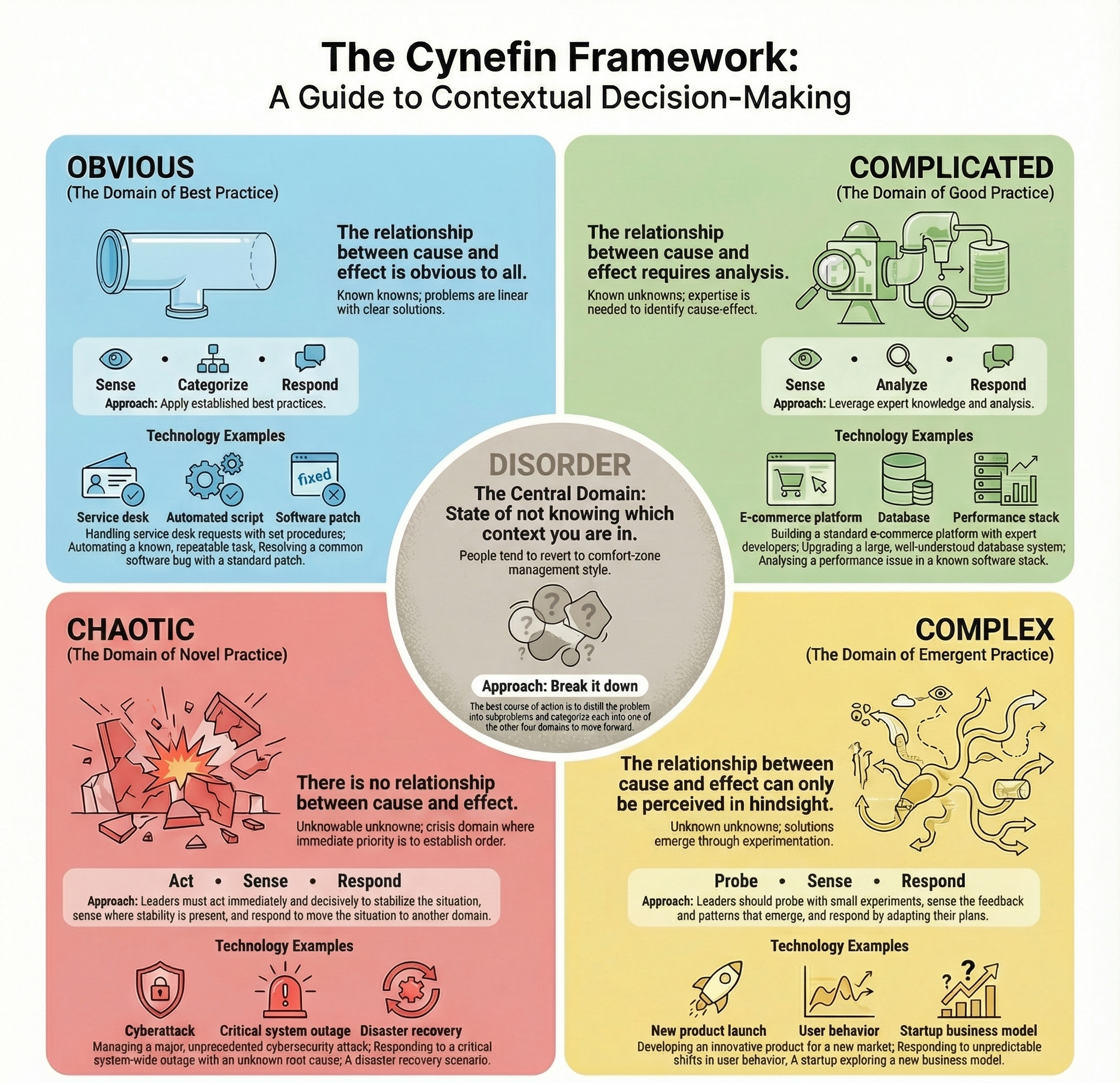
The Five Cynefin Domains in Practice
Take a moment to consider which of the five domains your current problem sits within.
Clear (Obvious)
In clear domains, cause and effect are well understood. The right answer is known.
These are areas suited to:
- standard operating procedures
- automation
- checklists
- delegation
The leadership task is to reduce variation and remove friction. Overthinking adds cost without adding value.
Technology examples include user provisioning, payroll processing, and routine infrastructure tasks.
Complicated
Complicated problems still have a right answer, but it is not immediately obvious. Expertise is required.
This is where:
- analysis matters
- specialists add value
- planning reduces risk
Multiple options may exist, but one will usually be better than the others. Leadership here is about creating space for informed judgement, not speed.
Examples include ERP design decisions, network architecture, or vendor selection.
Complex
In complex domains, cause and effect can only be understood in hindsight.
These problems involve people, behaviour, and uncertainty. They cannot be solved through analysis alone.
The appropriate approach is to:
- run small experiments
- observe results
- adapt based on learning
This is where Agile methods work well, not as a philosophy, but as a response to uncertainty.
Examples include new digital products, organisational change, or customer experience redesign.
Chaotic
In chaotic situations, there is no visible relationship between cause and effect.
The priority is stabilisation.
Leaders must act decisively to contain the situation, establish order, and reduce harm. Only once stability is restored can the problem be reframed into another domain.
Examples include major outages, cyber incidents, or sudden regulatory failures.
Disorder
Disorder exists when there is no shared agreement on which domain applies.
People respond based on comfort rather than context. Engineers look for analysis. Managers push for action. Leaders debate frameworks.
The task here is diagnosis. Until the domain is agreed, progress will remain slow and misaligned.
What Cynefin Changes in Practice
Used well, Cynefin shifts leadership behaviour in practical ways.
It:
- reduces premature certainty
- legitimises experimentation where needed
- reinforces discipline where it already exists
- lowers tension between speed and control
It also creates permission. Permission to slow down when analysis matters. Permission to test and learn when it does not.
A Tool for Leadership Teams
Cynefin is most powerful when used collectively.
It works well in:
- executive planning sessions
- portfolio prioritisation
- major project framing
- post-incident reviews
A simple question often changes the conversation:
“What kind of problem is this?”
Once that is clear, the right response usually follows.
Choosing the Right Response
Cynefin does not remove complexity.
It helps leaders avoid adding to it.
By matching approach to context, organisations make fewer avoidable mistakes. Teams experience less frustration. Outcomes improve not because people work harder, but because effort is applied appropriately.
For technology leaders operating across stability, change, and uncertainty at the same time, that distinction matters.
Often more than the decision itself.
References and Further Reading
Snowden, D. J., & Boone, M. E. (2007). A Leader’s Framework for Decision Making. Harvard Business Review.
The foundational article that introduced Cynefin to a broad executive audience and explains how leaders should act across different contexts.
Snowden, D. J. (2010). The Cynefin Framework. Cognitive Edge.
Practical explanations and examples directly from the framework’s creator, including its use in leadership and organisational design.
Kurtz, C. F., & Snowden, D. J. (2003). The New Dynamics of Strategy: Sense-making in a Complex and Complicated World. IBM Systems Journal.
Useful for readers interested in how Cynefin applies to strategy and decision-making beyond technology.
Cognitive Edge. Cynefin Framework resources and case studies.
A collection of real-world applications across government, enterprise, and technology leadership.