Agile Thinking: Working Effectively in Complex Problem Spaces
Design Thinking helps us understand the problems worth solving.
Lean focuses on improving the flow of value.
But in many situations, the reality doesn’t becomes clear until we start work. We don’t yet know exactly what the solution should be, and the environment keeps changing.
This is where Agile thinking matters.
Agile is not about stand-ups, backlogs, sprints, or story points. Those are practices. Agile, at its core, is a philosophy designed for environments where:
- requirements evolve
- customers learn as they see real outcomes
- technology and constraints shift as we build
- certainty only emerges through iteration
It is a way of working that accepts complexity instead of fighting it.
Why Agile Emerged
In the late 1990s, software projects were often run like construction programs:
- long upfront plans
- heavy documentation
- rigid contracts
- success measured by delivery against the plan
The result was predictable: teams delivered exactly what was requested, long after it was needed, at great effort, and often without solving the real problem.
A group of practitioners challenged the model. Instead of planning everything upfront, they asked:
What if we learned our way toward the right solution, step by step?
That thinking evolved into what became known as Agile software development.
The Philosophy Behind Agile
Agile is built on several core beliefs:
- People and collaboration matter more than rigid procedures
- Progress is demonstrated through working outcomes, not documents
- Customers should be involved throughout, not only at the beginning
- Change is expected — and often valuable
Importantly, Agile does not reject planning, process, documentation, or contracts.
It simply places greater value on:
- adaptability over certainty
- learning over assumption
- outcomes over output
For CIOs and executives, Agile challenges a deeper habit: the desire for predictability when predictability does not exist.
Working Inside Complexity
Complex problem spaces behave differently.
We cannot specify them accurately upfront.
We only understand them as we interact with them.
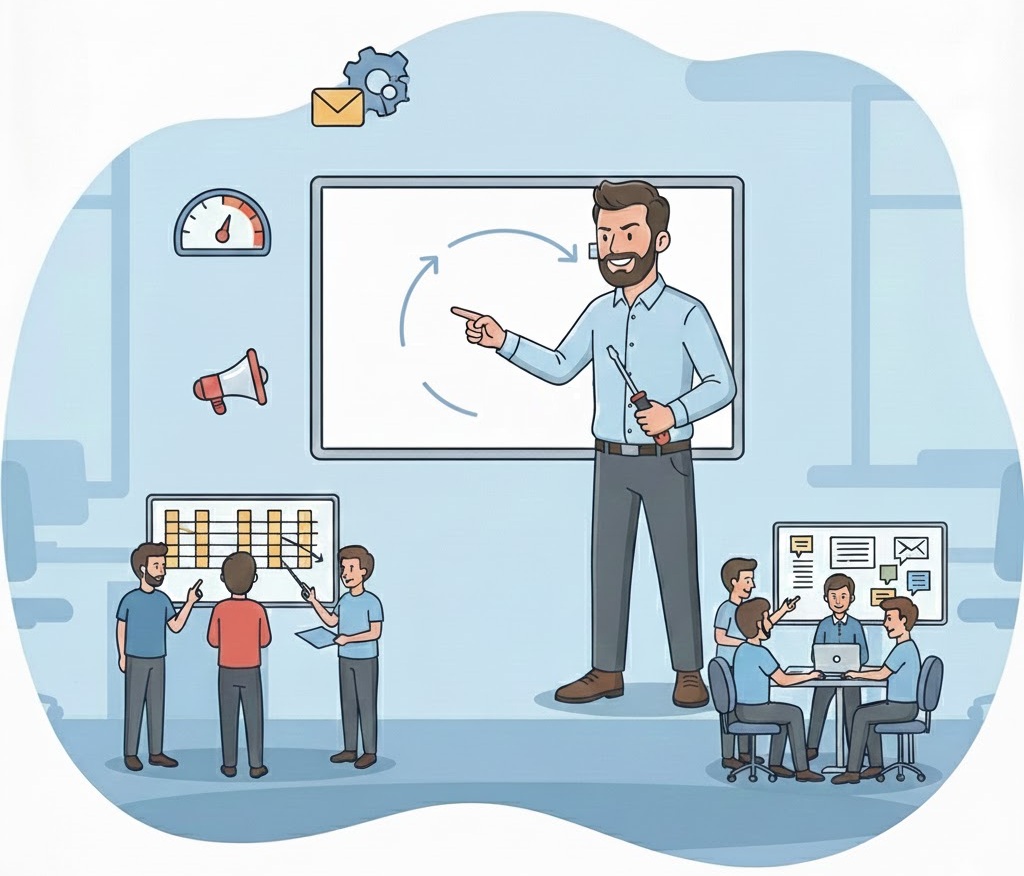
Agile responds by creating short, repeatable feedback loops where:
- something useful is delivered early
- customers react
- teams adjust direction
- knowledge compounds over time
Designs, architectures, and requirements emerge rather than being fixed at the start.
This is not lack of control — it is a different form of control, based on continual learning.
Interpreting the Agile Values in Practice
The well-known Agile statements are often misunderstood. In practice, they mean:
People and relationships come before strict processes
Frameworks are helpful. But judgement, trust, and intrinsic motivation do more to influence outcomes than procedure alone.
Working outcomes matter more than perfect documentation
Documentation supports clarity. But real learning occurs when something is used and tested in the world.
Collaboration beats contractual certainty
Complex environments cannot be fully predicted. Shared problem-solving works better than trying to lock everything down early.
Plans adapt as we discover more
Planning is continuous. We plan, act, learn, then plan again. Control comes from feedback, not forecasting.
None of this removes governance. Instead, governance shifts toward visibility, alignment, and learning.
Principles That Shape Agile Delivery
Agile delivery environments tend to share several behaviours:
- value is delivered in small increments
- customer input is continuous
- decisions are delayed until the last responsible moment
- teams reflect and improve regularly
- technical quality is protected to keep change possible
- simplicity is sought deliberately
These principles support a sustainable pace — not sprints toward burnout.
Two Practical Examples
Example 1: Rewriting an internal system
A leadership team wants to rebuild an aging internal platform. Traditional thinking suggests:
- define every requirement
- sign a large contract
- deliver everything at once
An Agile approach reframes the work:
- identify the highest-risk or most valuable capability
- deliver a minimal working version
- observe usage and impact
- continue iterating, replacing the system piece by piece
Risk reduces, learning increases, and investment tracks demonstrated value.
Example 2: Product roadmap uncertainty
A product team is under pressure to “commit” to a detailed 18-month roadmap.
Instead of resisting, Agile thinking separates direction from detail:
- articulate clear outcomes and strategic themes
- outline near-term work in more detail
- keep future work intentionally flexible
- review plans frequently as evidence emerges
Stakeholders still see intent and alignment, without forcing artificial certainty.
Where Agile Fits in the Series
Design Thinking helps reveal the right problem.
Lean Thinking helps value flow.
Theory of Constraints focuses improvement.
Agile sits alongside them as the philosophy for delivering inside uncertainty.
It reminds leaders that:
- not all problems can be predicted upfront
- discovery and delivery often happen together
- learning is a core part of the work, not a separate phase
Agile is not a methodology to install. It is a mindset that shapes how teams approach complex work.
When leaders treat it as ceremony, it fails.
When they create the conditions for learning, collaboration, and adaptation, it becomes a powerful way to reduce risk and increase value.
Further Reading
Beck, K., et al. Manifesto for Agile Software Development (2001).
Highsmith, J. Adaptive Software Development.
Schwaber, K., & Sutherland, J. Scrum Guide (for practice context, not philosophy).